AI for law firms is most useful where lawyers spend hours reading before they can start thinking: a thick investigation file, years of correspondence, a dozen witness statements. AI-assisted case assessment reads those documents and drafts a structured overview. The lawyer checks it and decides. Below I explain what goes in, what comes out, how the review works and what a firm should check before it starts. 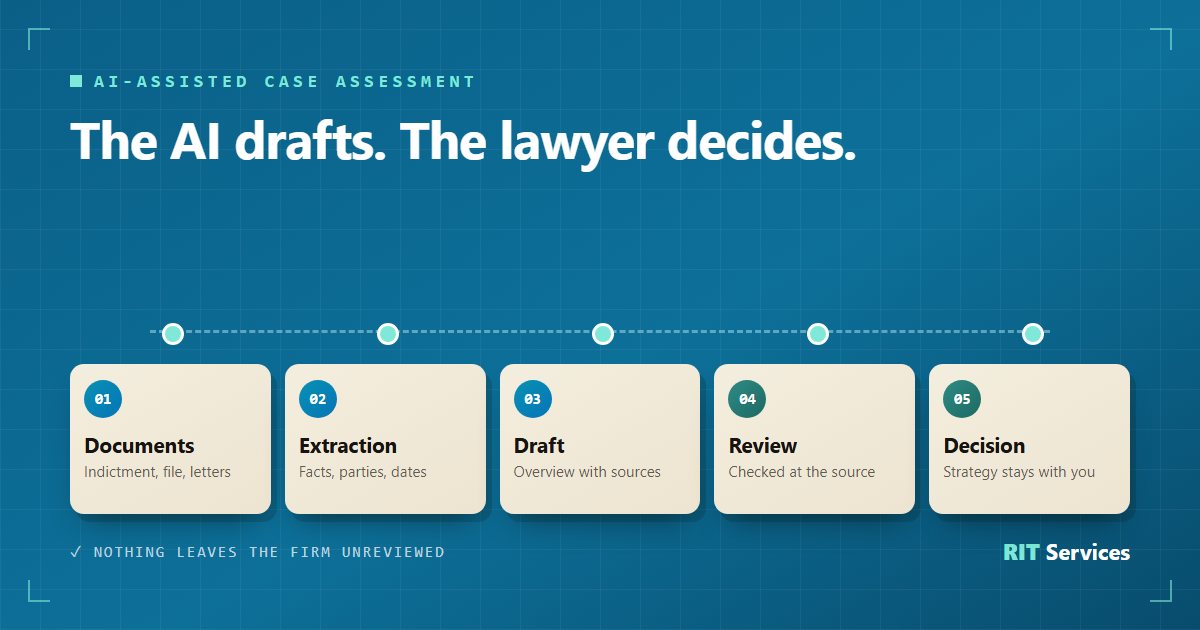 One point up front: this is a tool for lawyers, not legal advice for the public. Nothing it produces reaches a client without a lawyer's review.
What AI-assisted case assessment does, and what stays with the lawyer
An AI legal assistant of this kind does the preparatory reading. It is good at going through large amounts of text quickly and consistently, and at putting what it finds into a fixed structure. It is not good at judgement, and it knows nothing the documents do not say.
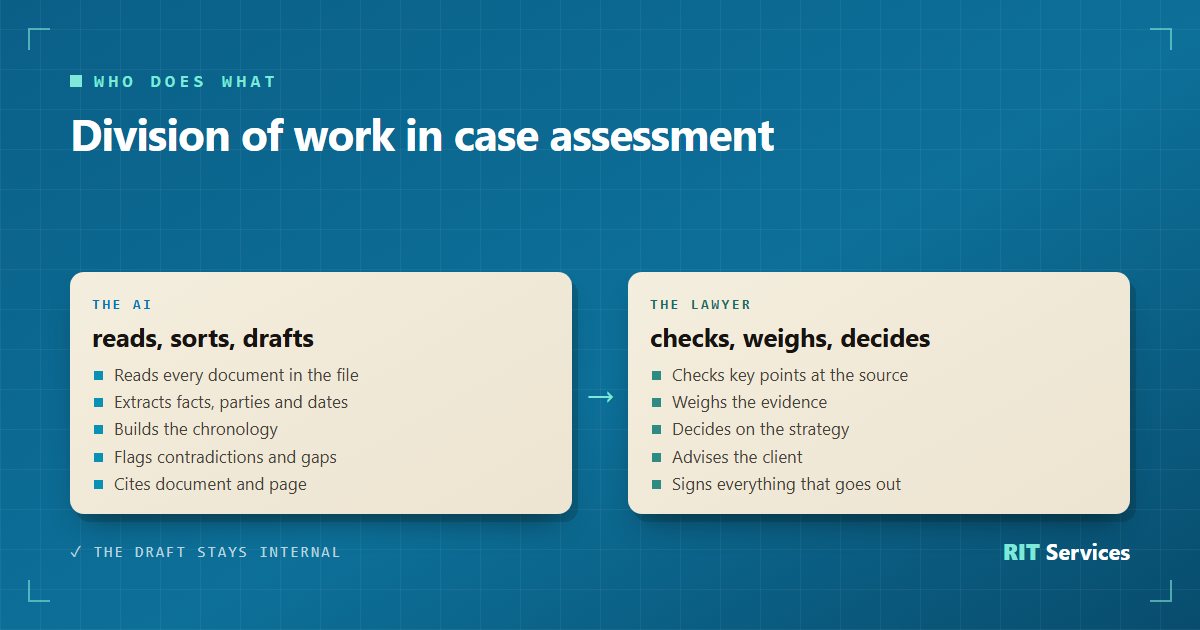
- The AI reads the documents, extracts facts, parties and dates, builds a chronology, lists open questions and points out where documents contradict each other.
- The lawyer checks the points against their sources, weighs the evidence, decides on the strategy and speaks with the client.
Which inputs it uses
The assessment works only with what the firm adds to the file. In criminal defence, typical inputs are:
- the indictment or the summons,
- the investigation file, once access to it has been granted,
- witness statements and expert reports,
- correspondence with the authorities and the court,
- the client's own account as recorded by the firm.
Scanned documents are converted to text first. Poor scans and handwriting remain a weak point, so the overview marks any passage it could not read reliably.
What the output looks like
The result is a working draft with a fixed structure, so every lawyer in the firm knows where to look:
- Summary of the matter in a few sentences.
- Chronology of events with dates.
- Parties and roles, including the authorities and their reference numbers.
- Allegations and evidence as the documents state them.
- Contradictions and gaps between documents.
- Open questions for the next meeting with the client.
Every statement carries a reference to its source, such as document and page. A statement without a source does not belong in the draft.
The fixed structure has a side effect: when a colleague takes over a matter or covers during a holiday, they find their way at once, without reading the whole file from the start.
How a lawyer reviews the result
AI legal software is only as good as the review around it. We recommend three rules:
- Check against the source. For every point that matters to the strategy, the lawyer opens the cited page. A wrong date or two witnesses mixed up are easy to spot this way.
- Mark what has been checked. Points are marked as confirmed, corrected or rejected, so colleagues can see what has been reviewed.
- Nothing leaves the firm unreviewed. Letters, submissions and advice to the client are written by the lawyer. The draft stays internal.
Would you like to see how this could work with your files? Book a free initial consultation and we will discuss which matters suit a first test.
Confidentiality, GDPR and the EU AI Act
Case assessment touches the most sensitive data a firm holds. For firms in Germany, four points matter:
- Professional secrecy. Section 43a(2) BRAO and Section 203 of the German Criminal Code apply. External providers may only be used under the conditions of Section 43e BRAO: careful selection, a contract in text form and a confidentiality undertaking.
- GDPR. You will usually need a data processing agreement under Art. 28 of the GDPR. In criminal matters, data about offences falls under Art. 10 GDPR and needs particular care. More in our article on deploying AI in a GDPR-compliant way.
- Hosting and training. Documents should be processed in the EU or on the firm's own infrastructure, and the AI model must not be trained on them.
- EU AI Act. Since 2 February 2025, organisations that use AI have to ensure their staff have sufficient AI literacy (Art. 4 of the EU AI Act). Which further obligations apply depends on the use case; our brief explanation of the EU AI Act gives an overview.
This is not legal advice; agree the details with your data protection officer.
What to check before introducing AI software for lawyers
- Start with closed matters. Test the assessment on files your team knows well. You will see quickly where it helps and where it gets things wrong.
- Set the review rule first. Before the first live matter, decide who checks what and how it is marked.
- Clarify the contract. Data location, deletion periods, no training on your documents and the confidentiality undertaking.
- Restrict access. Only the team working on the matter should see its assessment.
- Train the team. It covers the AI literacy duty, and everyone learns the tool's limits.
- Measure the time. Record how long the first reading of a file takes before and after, so you can judge the benefit in numbers.
How it fits with the rest of the firm's software
Case assessment works best when the documents already sit in one digital file. How an enquiry becomes a file is described in our article on law firm client intake software, and how the file itself is organised in the article on law firm case management software. We offer AI-assisted case assessment as a separate service alongside our software for law firms.
Thinking about AI for your firm? Book a free initial consultation. We will tell you honestly where it helps and where it does not.
FAQ: AI for law firms
Does AI-assisted case assessment give legal advice?
No. It produces an internal working draft for lawyers. The legal assessment and any advice to the client remain the lawyer's work.
Which documents can the AI read?
Text documents and scans, such as the indictment, the investigation file, witness statements and correspondence. Poor scans and handwriting are marked as uncertain.
How do I know a statement in the draft is correct?
Every statement refers to its source, such as document and page. The lawyer checks the points that matter against that source.
Can a German law firm use it under professional secrecy rules?
It can, if the conditions of Section 43e BRAO are met and the processing complies with the GDPR. Agree the details with your data protection officer.
Is our data used to train the AI?
It must not be. Make sure both the contract and the technical setup rule out training on your documents.